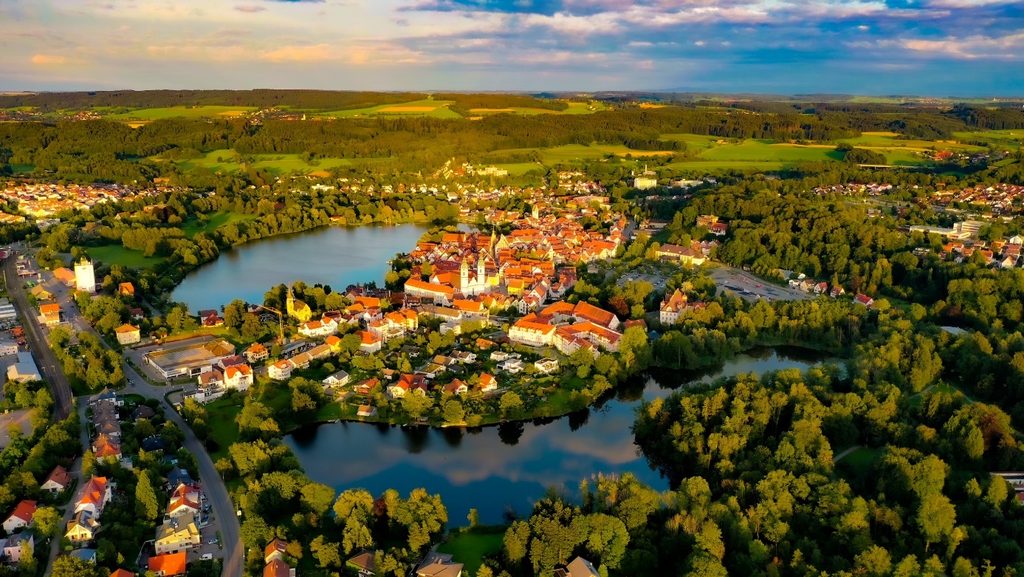
Town Lake & Castle Lake
Bad Waldsee’s town centre is surrounded by two lakes, the Town Lake and the Castle Lake. Both make a lasting contribution to the quality of life, and both are remnants of the last Ice Age, formed around 16,000 years ago when the Rhine Glacier melted. The Town Lake, which—as its name suggests—is owned by the town, covers 14.7 hectares, equivalent to just under 20 football pitches. It has a volume of 1,055,000 m³ and a maximum depth of 11.5 metres.
Unlike the Town Lake, the Castle Lake has been left to nature and is visible from only a few places. There, despite being in the middle of the town, you can experience the tranquillity that only a lake can provide.
Steinach Fen
Northwest of Bad Waldsee, where the municipal boundary meets that of the neighbouring town of Aulendorf, lies the Steinach Fen. Its name comes from the northwestern district of Steinach, which borders the area directly. From the nearby car park, which offers barbecue and sports facilities, the fen can be reached in just a few minutes on foot. Mostly narrow, unpaved paths lead through an unspoilt patch of countryside whose diversity of plants and abundant wildlife are exceptional.
Around 18,000 years ago, as the climate grew warmer, meltwater from the Rhine Glacier collected in depressions formed during the Würm glaciation. Over thousands of years, these bodies of water gradually silted up, developing first into fens and later into raised bogs. This process gave rise to the Steinach Fen. Pines and spruces grow in the drier areas, while mosses and reeds dominate the wetter zones; sundew also grows here. Waterlogged areas support plants such as cattails and marsh marigolds.
The fen is also home to countless species of dragonflies and butterflies, amphibians and reptiles, including the venomous common European adder. The abundance of insects provides ample food for a colourful variety of birds.
Grabener Höhe
One of the finest viewpoints
A hilly landscape such as southern Upper Swabia offers a number of ridges with rewarding views. One of the finest is undoubtedly Grabener Höhe (754 m), between the spa towns of Bad Waldsee and Bad Wurzach. Accessible from both north and south by narrow roads, this attractive destination can also be reached on foot, for example via the “Sebastiane”.
St Sebastian’s Chapel
The much-loved “Sebastiane”, deeply rooted in the surrounding villages, is a small chapel dedicated to St Sebastian (758 m). It can be reached above the village of Haisterkirch by a footpath laid out as a Way of the Cross. From there, a partly wooded ridge path leads to the Graben farmstead, only a few hundred metres from the actual viewpoint. Whichever route you take to Grabener Höhe, a small car park provides access to a spacious barbecue and play area surrounded by shade-giving trees.
From the Swabian Jura to the Alps
The view, however, is breathtaking and richly rewards hikers for their efforts. To the north stretches the broad Haistergau, with the outline of Bad Waldsee, while the Bussen—Upper Swabia’s Holy Mountain—rises on the horizon. In the distant haze lies the Swabian Jura. To the south, the view extends across the Wurzach Fen, a nature reserve awarded the European Diploma. Beyond it appear the foothills of the Allgäu and, farther still, the majestic peaks of the Alps.
Tannenbühl Recreation Area
A landscape for play and recreation
Over recent decades, Tannenbühl has gradually developed into a highly attractive recreation area southeast of the town. For Bad Waldsee families and school classes, enjoying this natural yet appealingly designed play and recreation landscape several times a year is almost a must.
Tannenbühl has much more to offer besides the climbing park. There are varied, nature-oriented play facilities for younger and older children, all meeting the latest safety standards. At the foot of the barbecue hut is a football pitch; the hut’s various barbecue areas can be booked through the Citizens’ Service Office. The wildlife enclosures on the steep slopes of the wooded moraine hills are especially popular. The municipal forestry service has created excellent conditions here for red deer and mountain wildlife. Visitors can observe the animals at leisure in a natural habitat. The Tourist Information Office also regularly offers guided forest walks.
Tannenbühl is also one of the town’s main areas for joggers and Nordic walking enthusiasts.
Durlesbach Station
On the Swabian Railway
Few German folk songs are as well known as “Auf d’r Schwäb’sche Eisebahne”. It has been sung thousands of times at regulars’ tables, passed down hundreds of times and fitted with new lyrics in versions of up to 27 verses—most recently during demonstrations against “Stuttgart 21”.
“Trulla, trulla, trullalla
Trulla, trulla, trullalla
Stuegert, Ulm ond Biberach
Meckebeure, Durlesbach …”
so goes the chorus, yet no one knows where Durlesbach is. Does this station even exist?
Yes—everyone in Bad Waldsee knows it lies down in the Schussen gorge in Reute, a district of Bad Waldsee. Locals are not bothered that this tiny hamlet entered the song only because it rhymed, and in the wrong order at that, since Durlesbach actually comes before Meckenbeuren. And so the Reute Durlesbach shawm band continues to play “its” song with great fervour, although the farmer who ties his goat to the train is really a caricature of an Upper Swabian.
After the Southern Railway from Ulm to Friedrichshafen was built in 1850, Tübingen fraternity students first sang the song in 1853 to a melody from Basel. In 1990, Bad Waldsee artist René Auer immortalised the station scene in four bronze figures. The little farmer, the stubborn billy goat, a farmer’s wife and the conductor stand beside a retired narrow-gauge locomotive as a railway monument. This makes the one-hour walk from Bad Waldsee to Durlesbach well worthwhile. After the line was expanded to two tracks in 1911, a new station was built, but it is no longer served.
Before returning, you can stop for refreshments at the station café and perhaps take a short walk along the Schussen. Then the walk back feels lighter, with the Swabian Railway song on your lips.
Activities in Bad Waldsee
Town Lake Activity Trail
Here, exercise and experiencing nature come together: the interactive stations around the lake invite you to get active, awaken your senses and leave everyday life behind. Discover the colourful variety of flowers along the trail, which not only delights the eye but also provides a home for insects and butterflies. Lovingly designed insect hotels create additional habitat for bees, beetles and other beneficial residents. Birds, fish and many other animals also live in and around the Town Lake and can be observed with a little patience. Experience the fascinating wildlife up close and enjoy recreation close to nature, exciting discoveries and unforgettable moments—experience Bad Waldsee right at its heart!
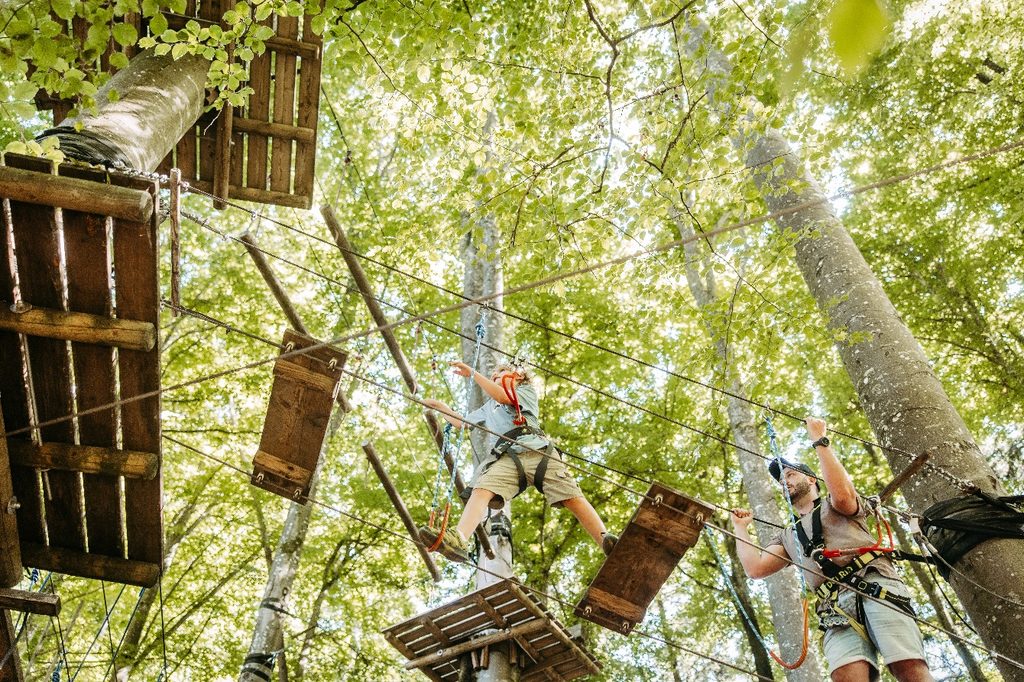
Tannenbühl Climbing Park
If you leave the town heading east, you will reach the Tannenbühl recreation area after about a 30-minute walk along well-signposted paths. Visitors arriving by car will also find a spacious car park before the paths lead into the heart of the forest. Active visitors can discover Tannenbühl’s newest attraction here: the climbing park. During the winter months from November to March, the park opens to visitors at weekends when the weather is dry and frost-free. For the rest of the year, its gates are open daily—always under the guiding principle “Safety first…”
Starting with young children aged three and above, visitors can choose from nine different courses tailored to climbers’ courage and physical fitness. Heights of up to 20 metres are reached. With straightforward guidance and excellent advice from the knowledgeable staff, each climber can select the course best suited to them.
The park caters not only to individual climbers; tailored packages are also available for school classes, companies and clubs. A well-stocked kiosk is available for refreshments after hours of climbing fun.
Minigolf
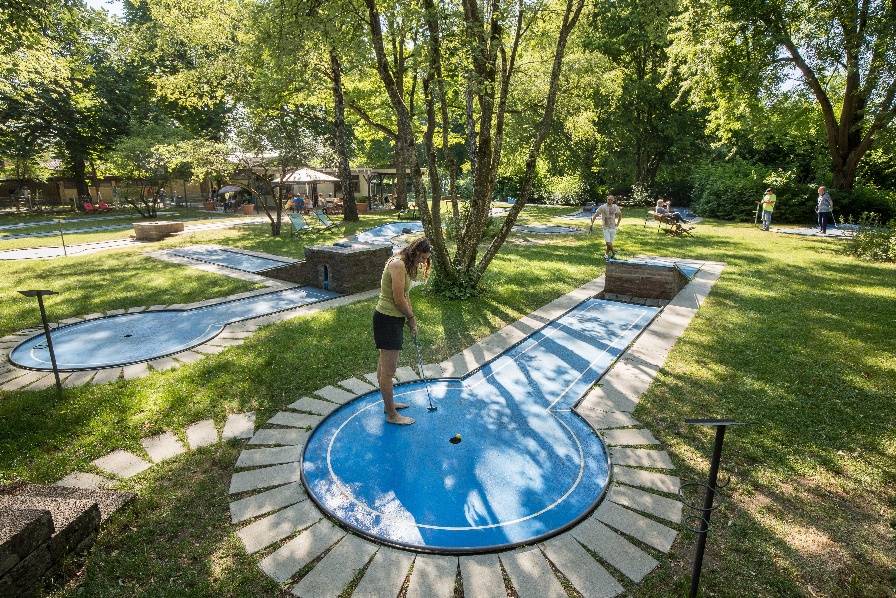
Mini-golf course directly beside the Town Lake
A mini-golf course is also part of the leisure activities offered by the town of Bad Waldsee. Located directly beside the Town Lake, the course stands out for its proximity to the old town and the municipal lido and outdoor swimming pool.
The 18 holes, with varying levels of difficulty, provide plenty of variety and repeatedly challenge players’ skill. Next to the mini-golf course there is also a kiosk serving coffee, cake, drinks and food, as well as a spacious terrace.
Guided Tours
Town Tours
A Walk Through the Historic Old Town
Church, nobility and citizens: Bad Waldsee as a complete work of art.
Bad Waldsee lies between two enchanting lakes and has an extraordinarily fascinating history. Austrian for five hundred years, pledged for centuries to the Princes of Waldburg-Wolfegg and, from 1806, an administrative centre of Württemberg—an impressive career! The town was home not only to three monasteries and the moated castle of its pledge-holder, but also to a self-confident citizenry that commissioned Upper Swabia’s finest Gothic town hall. The magnificent buildings of the historic centre bear witness to the rivalry among the church, nobility and proud citizens over the centuries. Bad Waldsee can also boast Baroque treasures, notably the Collegiate Church of St Peter and the Frauenberg Chapel. A guided walk through the lively old town, with its many small shops and cafés, introduces you to a small town with a great history.
Duration: approx. 90 minutes
Price: from €60
Meeting point: by arrangement
Spooky Tour
The Flourishing of Superstition: Protective Symbols from (Not So) Long Ago
Ghosts, spirits and restless souls? They were said to exist in Baroque-era Bad Waldsee too! Schrättele, witches and even the devil—in the form of Hans Federle—were believed to have caused mischief here. All kinds of curious objects were used in attempts to ward off these terrifying evils. Fig-hand amulets, breverl, “Judenbeinchen” and many other bizarre items served as protection against evil and the supernatural. The eerie tour ends with a stop at “Beim Josl” or in the cellar vault of the “Grüner Baum”. There, roof tiles from the 17th and 18th centuries bear various protective symbols intended to guard against evil spirits, witches and other fiends thought to threaten houses and their occupants from the air.
Guide: Paul Sägmüller
Duration: 90 minutes
Price: €100 for a maximum of 25 participants (on request: refreshments afterwards at participants’ own expense)
Meeting point: Cemetery chapel (Friedhofstraße)
Special notes:
- The tour is only available after dark!
- On request: refreshments afterwards with the town guide—please mention this when booking.
Town Hall Tour
Guided Tour of Bad Waldsee’s Historic Town Hall
On this approximately 45-minute tour, discover the history and distinctive rooms of Bad Waldsee’s Historic Town Hall. The council chamber and mayor’s office are among the rooms visited. Learn interesting facts about the building’s historical significance and gain fascinating insights into one of the town’s most important landmarks.
Duration: approx. 45 minutes
Meeting point: beneath the town hall arcades (at the Historic Town Hall)
Price: from €40
Museums
Museum in the Kornhaus
Regularly changing special exhibitions are held on the ground floor. Bad Waldsee’s current anniversary exhibition can be seen until the end of September 2026.
On the first floor, the museum presents its permanent exhibition on the art, history and culture of Bad Waldsee and the region. Divided into the themes “Citizens—Nobility—Church”, the exhibition uses documents, works of art and historical objects to trace the town’s development from an Austrian market town to an administrative centre of Württemberg.
Another focus is the history of the House of Waldburg, in particular Georg III of Waldburg, known as the “Bauernjörg”, as well as the formative role of the church and monasteries in Upper Swabia. Mementoes of Blessed Good Beth of Reute illustrate the region’s religious tradition.
The exhibition also provides an overview of art history from the Middle Ages to the present day. A particular highlight is the important sculpture collection of the Zürn family of sculptors from Waldsee, who were among the pioneers of the Baroque in southern Germany and Austria.
“kleine galerie” Art Space
The exhibition programme ranges from painting and sculpture to innovative multimedia artworks, offering a broad cross-section of contemporary art forms. This versatile approach makes the “kleine galerie” a place that provides a platform for both established artists and emerging talent.
Since 2004, the “kleine galerie” art space has been located in the Haus am Stadtsee, although the exhibition format itself has existed since 1965. In 2025, the “kleine galerie” therefore celebrated its 60th anniversary.
Erwin Hymer Museum
A Journey of Discovery Through Mobile Travel
The Erwin Hymer Museum in Bad Waldsee invites visitors on a unique journey of discovery through the past, present and future of mobile travel. More than 80 motorhomes, caravans, cars and trailers from past decades are displayed across approximately 10,000 square metres. Exhibits include motorhomes from the 1930s, the original 1955 Troll—the first mobile vehicle produced by motorhome manufacturer Hymer—and exceptional items on loan.
The permanent exhibition on cultural history and technology invites visitors to join the journey. Designed for young and old alike, it is an experience for the whole family. Together, visitors travel along the world’s dream roads to faraway destinations. They learn about the cultural and historical background of mobile travel, immerse themselves in the stories of its pioneers, discover fascinating insights into technology, development, production and design, and explore the dream destinations of different eras—from the Adriatic and the Baltic Sea to the United States and India. As a souvenir, visitors can have their photograph taken at the individual “dream destinations”. At the end of the exhibition, the image is displayed on a large globe alongside many journeys actually undertaken by motorhome travellers. The photograph can be purchased in the museum shop as a postcard with greetings from Bad Waldsee.
Fasnet & Oil Mill Museum
History and Traditions
At the Waldsee oil mill, visitors can clearly see how linseed, poppy-seed and rapeseed oil are produced. The machinery, including its millstone, dates from 1829 and is operated by the waterwheel during visiting hours. The high-pressure oil press dates from 1919. The building also houses the Fasnet Museum, run by the Narrenzunft Waldsee e.V. The history and customs of Waldsee’s Fasnet carnival are presented vividly. Masks, costumes and a pictorial chronicle bring the tradition of the colourful festivities to life.
If you have any questions, or would like to book an activity such as a guided tour, please contact the Bad Waldsee Tourist Office.